
Written by Aram
Founder & Designer, Lovely Moments Planning
Reviewed & updated August 28, 2026
Short answer
A strong corporate event starts with one measurable business objective, then builds the audience journey, content, venue, production system and show flow around it. The final control documents should include a decision log, floor plan, technical plan, production schedule, speaker brief and run of show with named cue owners.
At a glance
The production path
| Stage | Key decision | Proof it is ready |
|---|---|---|
| Strategy | What should the audience think, feel or do? | One objective, audience definition and success measures |
| Experience | What sequence earns attention? | Agenda, guest journey, format and content architecture |
| Production | What systems make it work? | Floor plan, technical scope, crew plan, schedule and contingency |
| Show call | Who cues each live moment? | Timed run of show, rehearsed speakers and clear communication channels |
| Closeout | What will be learned and reused? | Attendance, engagement, leads, content assets, costs and debrief |
Before the venue search
Define the business objective, audience, required actions, budget range, decision makers and non negotiable dates. A product education session, employee celebration and customer pipeline event can have the same guest count but need completely different spaces and production.
Build the format before the floor plan: arrival, registration, opening, content blocks, breaks, networking, departure and follow up. Every transition needs enough time and an owner.
- Audience and accessibility needs
- Program length and content owners
- Venue capacity, sightlines, acoustics and load in
- Registration and privacy requirements
- Measurement and post event follow up

In the final two weeks
Freeze the room layout and technical scope, confirm every vendor arrival, issue the production schedule, collect final presentations, rehearse high risk transitions and resolve open decisions. A show caller should be able to read the run of show and know what happens, when, who triggers it and what the fallback is.
Create separate documents for guest facing agenda and crew execution. The guest agenda explains the experience; the run of show controls it.
Firsthand perspective
From the planning desk: protect the opening minute
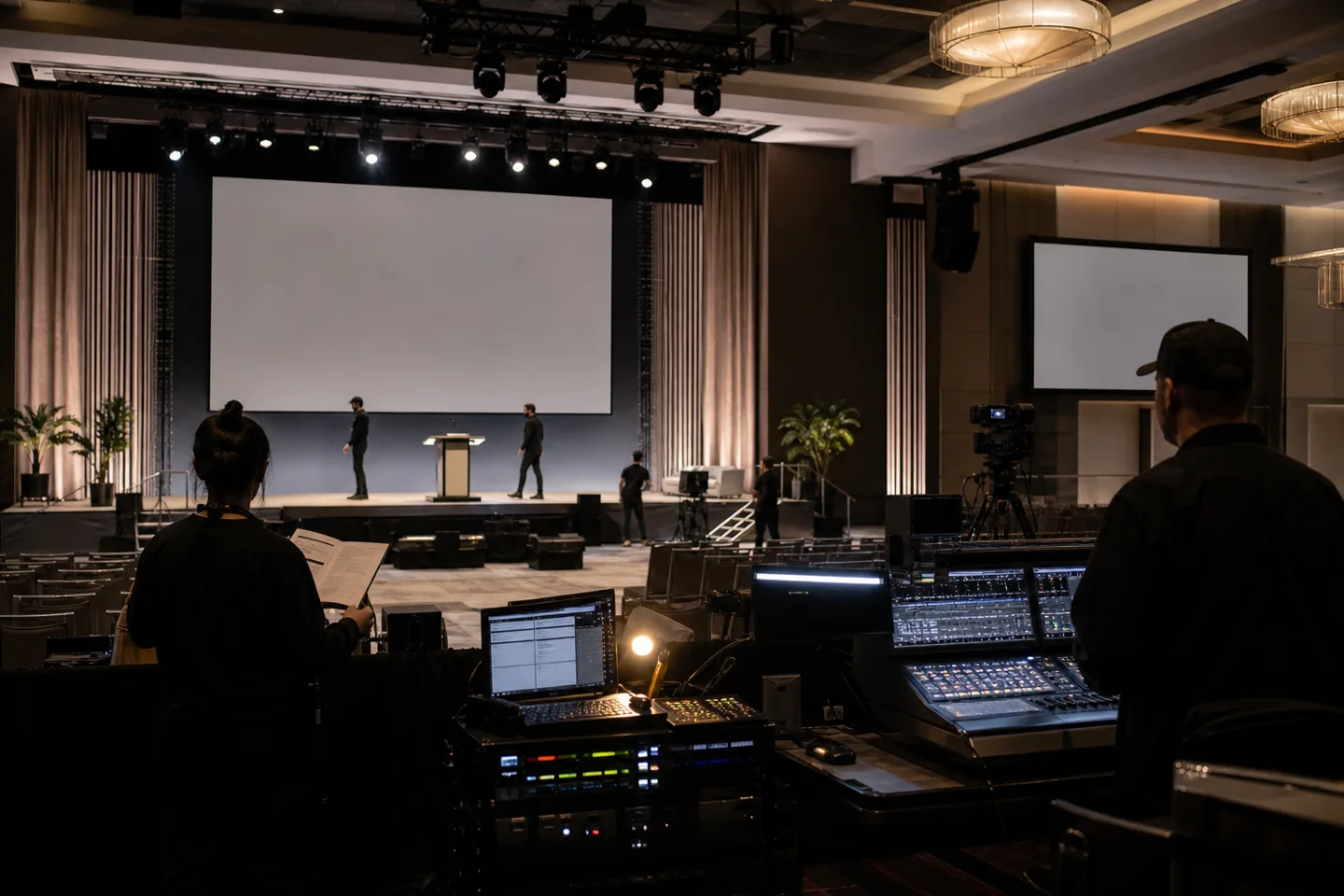
For a leadership program, the highest risk moment is often the first handoff: house lights fade, walk in music stops, the opening visual rolls and the host takes the stage. Rehearse that sequence with the actual files, microphones and cue language. A confident first minute changes how the room receives everything after it.
Illustrative composite based on common corporate show flow risks.Use this list
Show ready checklist
- 01 Objective, audience and metrics approved
- 02 Venue contract and access schedule reviewed
- 03 Floor plan and accessibility route approved
- 04 AV, power, internet and crew scoped
- 05 Speaker content received and rehearsed
- 06 Run of show timed with cue owners
- 07 Backup files, microphones and critical contacts on site
- 08 Post event reporting and follow up owners assigned
Cited external facts
Sources and fact checks
- 1
Cvent recommends setting clear event goals early and connecting objectives to the broader event strategy. Cvent Event Strategy Guide ↗
- 2
PCMA describes the run of show as the at a glance framework for the program rather than the full script. PCMA Institute ↗
- 3
The ADA National Network’s temporary event guide covers planning strategies, common barriers and resource coordination for accessible events. ADA National Network ↗
Sources were reviewed on August 28, 2026. Agency rules, prices and vendor guidance can change; confirm current details before contracting or filing.
Plan your next event with Lovely Moments Planning
Full service event strategy, planning, design and production for the San Francisco Bay Area and destinations beyond.
Explore corporate event services · View selected work · Start your inquiry